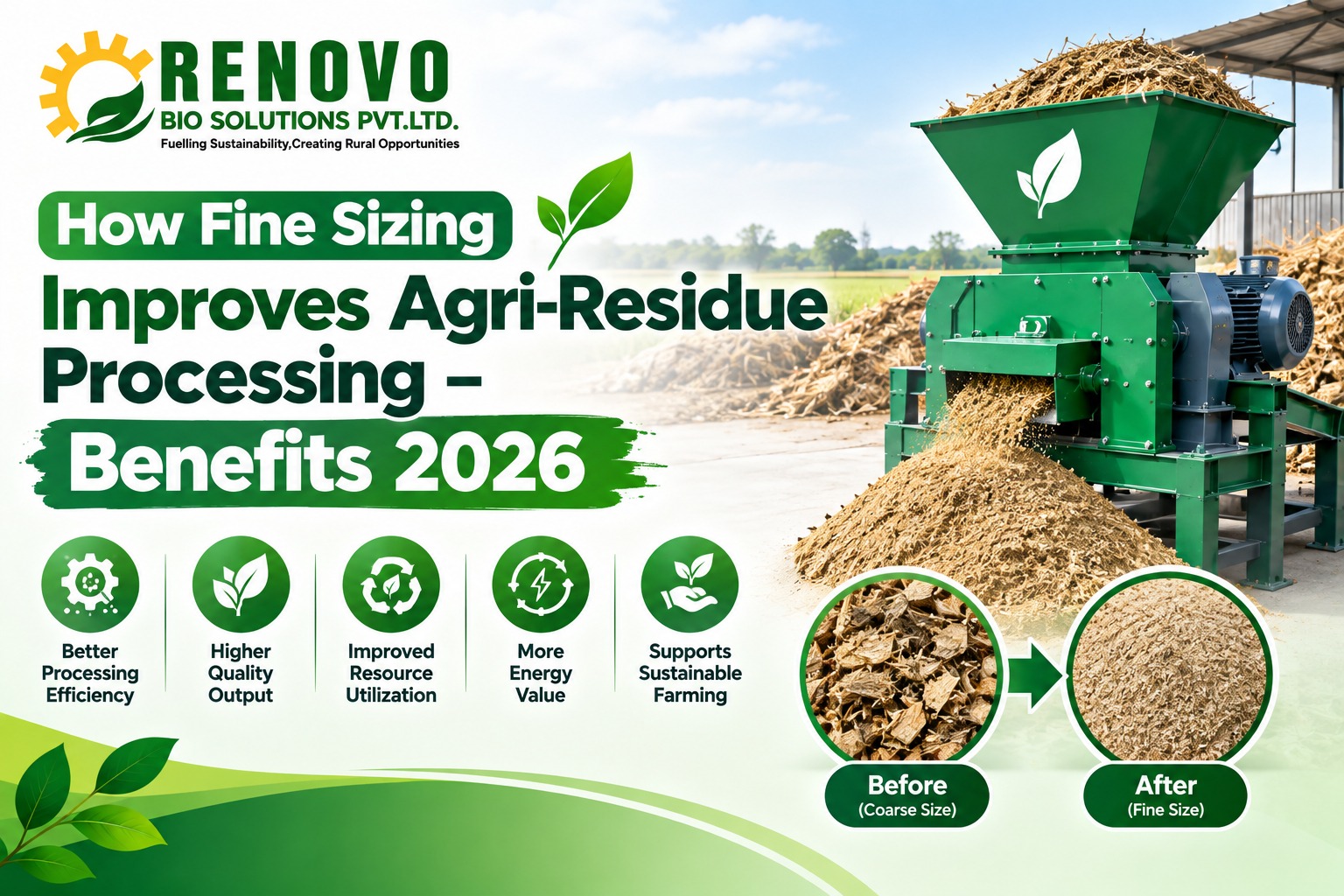
Fine sizing is one of the crucial steps in agri-residue processing as it influences the performance of the equipment that follows in a crucial way. Renovo Biosolution prioritises practical biomass processing solutions, which take into account biomass properties, plant size, maintenance and operating costs, instead of just going by the name of the technology. The processing methods and characteristics of the various sizing technologies can provide a deeper understanding of the processing characteristics of paddy straw and cotton stalk, and help Fine sizing establish a more robust processing line.
Why Fine Sizing Matters in Agri-Residue Processing
The agricultural residues are not a homogeneous material. Paddy straw is a high silica, ash containing material whereas cotton stalk is a coarse, woody and fibrous material with a relatively high lignin content. The above characteristics have a bearing on the nature of the size reduction of the material.
The fine sizing will help to produce homogeneous particle size for further processing. This would however require equipment which could withstand abrasive feedstock, variable moisture as well as plant capacity.So for commercial CBG plants, it is necessary to consider the overall operating environment, and not just opt for the technology that provides Finest Sizing.
Hammer Mills and Extrusion-Based Systems
In the market there are two primary technology solutions to the problem of final sizing of biomass.
High-speed hammer-milling systems break materials by the action of high-speed mechanical forces and shear. The biomass is subjected to screening and/or grinding against screens or grinding surfaces before which the operator can adjust the final particle size depending on the setting.The systems based on extrusion are different. Compression and shear as the biomass is transferred through a screw and die. In addition to mechanical and thermal effects, depending on the system design, there are also other factors that can disrupt material.
Silica and Abrasive Wear in Paddy Straw
The content of silica in paddy straw may be quite high and the total ash content is generally between about 14–18% depending on the source and the conditions. This results in an environment that is likely to cause wear on size reduction equipment.
The main wear item for a hammer mill is the hammers and screens. These are relatively simple modules which can be replaced, reversed or serviced without the need to tear the entire processing system apart.This is especially true if the plant is obtaining residues from various agriculture areas. An example is the handling and residue properties of feedstock that comes from Patiala in Punjab may be different and equipment durability, ease of maintenance are factors to consider.
Cotton Stalk and Coarse Fibrous Feedstock
A similar mechanical problem is encountered with cotton stalks. Coarse, woody, fibrous and has a relatively high lignin content. Therefore the equipment should be able to deliver enough impact energy to achieve the breakage and deliver stable throughput.
The principle of hammer mill design is to have repeated impact and controlled discharge of particles. The parameters of the whole hammer set, such as configuration, rotor speed, screen opening and motor power can be adjusted depending on the required processing conditions.
Maintenance and Wear-Part Replacement
Fine-sizing equipment selection is crucial and maintenance economics are a key component. In agricultural situations, a continuous abrasive loading may be caused by the agricultural residues, so that wear becomes an inevitable phenomena.The wear is typically focused in the replaceable parts of hammer mills, like hammers and screens. These components can be replaced and maintained during scheduled downtime to minimise extended periods of downtime.
Throughput and Capacity Scaling
There are a number of ways to scale hammer mills, motor power, rotor configuration and screen area. It is possible to often size up equipment and/or consider parallel arrangements to increase the throughput requirement.However, there are some practical restrictions in the extrusion systems due to screw diameter, screw length, screw torque, thermal restriction and wear. If the capacity is higher, work may need to be carried out using two or more trains of extruders, which may lead to a higher capital investment and complexity of control.
Handling Variable Moisture and Feed Conditions
The moisture content of agricultural residues is not even on a daily basis. The characteristics of feeds may be affected by bale condition, storage time, weather, transportation and the source of the feed.
Fine-sizing equipment must have a tolerance for reasonable changes without the need to constantly be recalibrating. Comparatively forgiving operation can be achieved by using a Hammer Mills as the smaller size of the product is determined by the screen size, and the impact of the mechanical process will take care of the variations in the material fed in.For instance, feedstock collected from Tezpur in Assam might have different seasonal and handling conditions as compared to that collected from agricultural areas of Punjab. This is the reason for sizing systems to be considered based on actual feed.
Downtime and Plant Availability
Availability of the equipment translates into overall plant utilisation for CBG plants. Fine-sizing equipment is not only required to meet the particle size specifications, but also be easy to maintain.
Most of the wear parts of the hammer mills are easily accessible and replaceable, making their service relatively quick. Other components such as hammers, screens, bearings and others can be routinely inspected as part of the scheduled maintenance.When precision-machined parts wear out, it might be necessary to undertake more specialised maintenance on the extruder. Replacement or refurbishment may be more expensive, and take longer to order.
Why Hammer Mills Can Suit Agri-Residue CBG Plants
Hammer mills are available for commercial tonnages of paddy straw and cotton stalk, and are suitable for variable feed conditions, they are also mechanically simple and have replaceable wear parts and are capable of scaling up the tonnage.Fine sizing can be considered in the entire agri-residue processing system, including feed preparation, moisture, throughput, equipment wear and requirements for downstream operations, by Renovo Biosolution.
Regional Feedstock Considerations
Agricultural residues are likely to be collected from several different sources by biomass plants. There may be variations in crop type, bale construction, bale moisture, storage and transport within each region.
If a plant is using a material from which Hoshiarpur in Punjab, the area of origin of the feedstock, has supplied the material, it is likely to be different in terms of feedstock characteristics than if it is using agricultural residues from another state. When designing the fine-sizing stage the differences should be taken into account.The equipment should be flexible enough to accommodate the realistic variations without the introduction of frequent interruptions to the throughput or a decrease in throughput.
Fine Sizing Trends for 2026
Biomass processing is getting more and more integrated with the equipment selection process in 2026, instead of separately addressing the selection of a specific piece of equipment. Together, considering energy use, plant maintainability, automation, throughput, plant wear management and feedstock variation in plants.The use of moisture monitoring, better screen configurations, automated controls, condition based maintenance, and equipment integration can all help to ensure more stable operation.
How to Select Fine-Sizing Equipment
When considering a fine sizing system, plant operators should consider:
The type of agriculture residue relates to the name of the agricultural product.
- The amount of silica and ash present
- Feedstock moisture range
- Required particle size
- Target plant throughput
- Motor power requirements
- Wear-part availability
- Maintenance turnaround time
- Feedstock variability
- Energy consumption
- Downstream process requirements
Why a Complete Processing Approach Matters
Nearly all the processing steps in both the up and down stream of biomass processing are linked to fine sizing. The biological processing process must be coupled with bale preparation, shredding, moisture management, milling, conveying and then biological processing.
When other equipment has enough capacity, but there is a mismatch at size it can cause bottlenecks. Likewise, if a needlessly complicated system is chosen, maintenance and operating expenses are higher but do not necessarily result in a greater gain.Renovo Biosolution can assist in defining the fine sizing for agri-residue processing based on actual need considering the practicalities of the equipment, behaviour of the feedstocks and economics at plant scale.
Conclusion
Fine sizing is more than just being a smaller particle size of agricultural residues. The technology should be capable of dealing with abrasive materials and varying moisture, fibre structure and commercial throughput and should be easily maintained.
At the 10–15 TPD scale of the Hoshiarpur In Punjab, hammer mills can be used as a balanced solution as they operate on impact, have replaceable wear parts, their configuration can be scaled for increased production capacity and maintenance is relatively easy.This should ultimately depend on what the feedstock is, how much capacity is required, the maintenance plan and the needs of the downstream system.Renovo Biosolution can assist in the development of biomass processing systems with an application-oriented approach with fine sizing included as a part of the plant's design and not as a standalone equipment selection.
FAQs
1. Why is fine sizing important for agri-residue processing?
Fine sizing may help to obtain a uniform biomass structure for efficient downstream processing and may help material handling and process stability.
2. Why are hammer mills commonly considered for paddy straw?
Silica and ash can be present in high concentration in paddy straw. The wear parts in a hammer mill are easily replaced, such as hammers and screens, a maintenance which is relatively simple.
3. Can hammer mills process cotton stalks?
Yes. Depending on the feed preparation, moisture, capacity and particle size desired, the following materials can be processed in a hammer mill: coarse and fibrous materials like cotton stalk.
4. How does an extruder differ from a hammer mill?
High speed impact/shear against a screen is primary in a hammer mill and compression/shear as material passes through a screw and die is primary in an extruder.
5. Which factors affect fine-sizing equipment selection?
The type of feedstock, moisture, silica and ash content, required particle size, throughput, energy consumption, wear, maintenance requirements and downstream processing requirements should be taken into account.
6. Is extrusion unsuitable for biomass processing?
No. If you have a suitable feedstock, and can control the moisture level, fibre quality and flow rate, then extrusion can be beneficial.
7. Why is maintenance important for CBG plant sizing equipment?
Regular wear is expected when processing agricultural residues. Equipment with accessible and replaceable wear components can simplify routine maintenance and help reduce unplanned downtime.