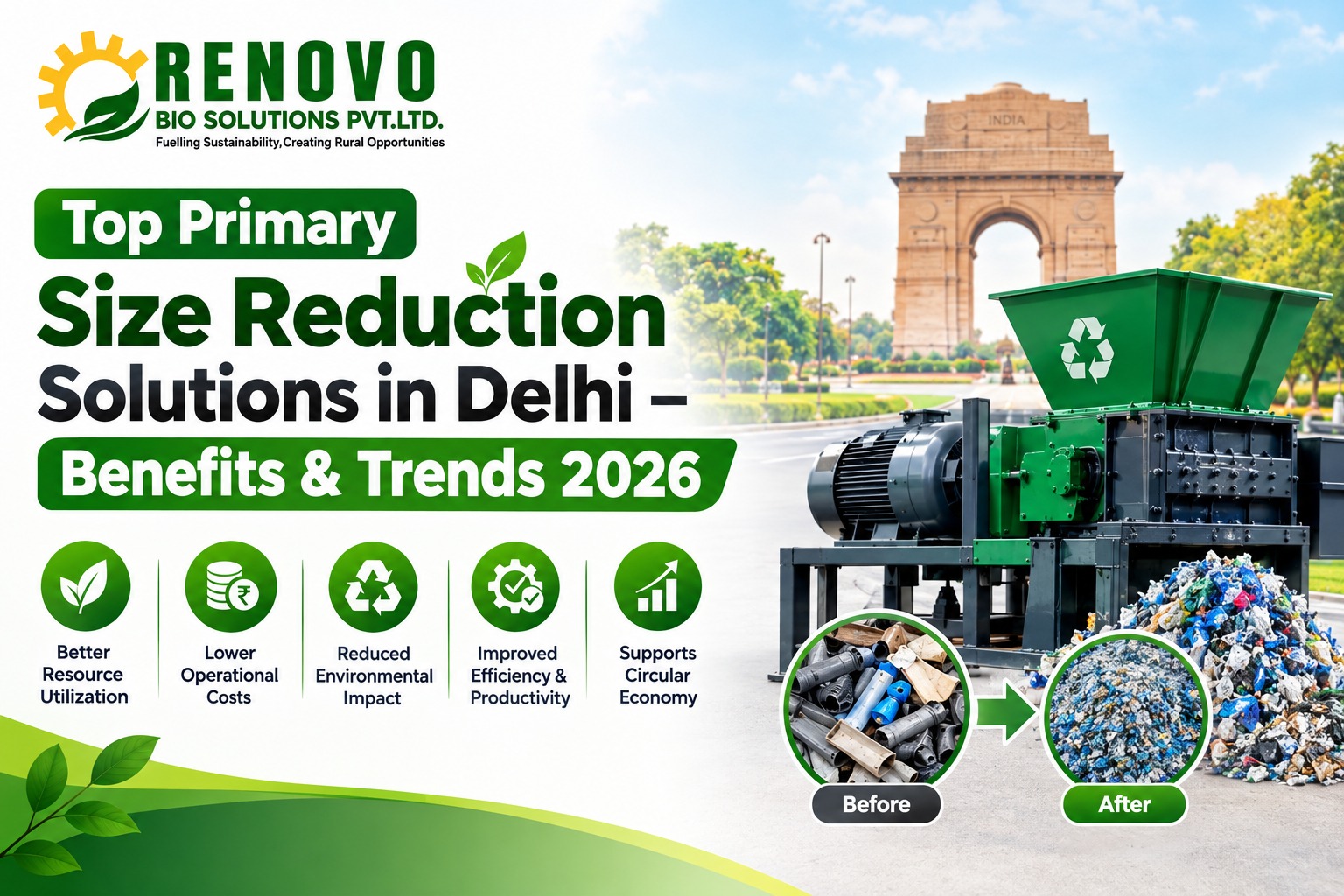
The first problem with processing agricultural residue is that many plants are not able to deal with the problem of irregular bales. Bales of agri-residue that arrive at a plant gate are seldom standardized and may include various bales from different sources. Small square bales weighing approximately 15-25 kg, round bales of 200-350 kg or large square bales of 500-600 kg can be given to a plant. This variation makes Primary Size Reduction an important process step to ensure a stable and efficient processing line.
Different bale formats have the potential to directly affect plant performance for plants handling agricultural residue in various regions including Delhi. Renovo Biosolution's philosophy is on solutions that can be implemented in the process to help the plant overcome changing raw-material conditions and ensure the consistency of the feed for downstream equipment.
Understanding the Challenge of Variable Bale Sizes
Often plants do not have any control over the bale format arriving in the most economical way. So the shredding stage should not be optimised for the use of just one bale size. If a large square bale is presented to a system designed for only small square bales, it could cause a problem.
This can cause bridging, equipment overloading, frequent stops and manual interference. The smooth operation of the first stage of size reduction can have an impact on the remainder of the process if it does not go smoothly. Hammer mills can be fed with variable material and the dryer may have variable feed characteristics. That's why it is important to consider flexible equipment selection in Primary Size Reduction planning.
Why Flexible Primary Size Reduction Matters
The shredder needs to easily fit a variety of bales formats, without having to change the process considerably. When the plant must accommodate smaller and larger bales, aspects such as adequate infeed dimensions and cutting geometry and sufficient drive torque are important.
For instance, agricultural residue from the Guna area in Madhya Pradesh may have different bale specification compared to the one received from the other areas of Agriculture. Likewise, plants associated with the supply chain near Nagpur Maharashtra or Hyderabad (Tamil Nadu) are likely to have to be able to handle different types of raw materials. Objectives do not only involve shredding but creating a dependable, controllable feed for the subsequent processing stage. Renovo Biosolution is committed to the notion that it is essential to take raw-material variability into account during plant design, and not try to resolve feeding issues afterwards.
Key Benefits of Primary Size Reduction
Good size reduction from the start of an agricultural residue line will offer a few advantages for the operation of the line.
Consistent Material Feeding
A good shredding system can diminish the size and irregular shapes of bales. This will help to maintain a uniform material flow to downstream equipment.
Reduced Unplanned Downtime
The use of equipment that will accept various bale sizes or types can prevent jamming, stalling and re-handling. This helps to ensure smooth operation of plants.
Better Downstream Performance
The hammer mill, dryer and other processing equipment require reasonably consistent feeds of materials. Avoiding fluctuations in the system, usually by adequate initial size reduction, can help to prevent them from impacting downstream performance.
Greater Processing Flexibility
Multiple raw-material sources require equipment that is capable of handling different raw-material conditions for plants that use agricultural residues as a raw material source. The ability to process a variety of materials in the same size reduction line is known as "flexible size reduction.
Designing for Large and Small Bale Formats
The largest bale expected and the infeed capacity of the shredder are some of the most critical factors to consider. If a bale that is outside of the average size is introduced into a system that has been designed for the average bale size, it may not work as expected.
Thus, the shredder should be of adequate opening size and have enough driving power to accept the largest possible size of the bales, regardless of whether they come from Nagpur in Maharashtra, or another location, but still be efficient in shredding the smaller sizes. By doing this the common design problem of having equipment operating best under ideal conditions and becoming inefficient when faced with actual raw-material variation, can be avoided. Renovo Biosolution points out to the designer the need to consider the nature of the feed in the real world and not to take a stance based on a uniform material.
Primary Size Reduction and Plant Efficiency
The first size reduction stage may have an impact on the efficiency of the entire processing line. Downstream machines may need to adjust for the varying feed characteristics if feeds are too large, or improperly cut or shredded.
A good system design can produce a more uniform material stream prior to going into the hammer mill and dryer. This can help to make the process more stable and minimize the pressure to the process due to irregular feed. Knowing the local sourcing pattern and the type of bales produced for the surrounding areas of Guna in Madhya Pradesh, Nagpur, Maharashtra and Hyderabad in Telangana can, therefore, be an important aspect of equipment planning for agricultural residue plants.
Trends in Primary Size Reduction for 2026
In 2026, processing of agricultural residues is more in focus on flexibility, process continuity and optimisation of process integration between individual processing steps. Plant designers are looking at broader ranges of material conditions, rather than just the one they are designing for.
Also, there is a trend towards minimising the level of manual manipulation and towards improving the transition between the stages of shredding, milling, drying and further processing. This is an even greater significance for plants where agricultural residues vary in size, as adaptable Primary Size Reduction systems become more and more pertinent. Another important consideration is designing the equipment so that it will have enough capacity, but at the same time not be using too much capacity when fed with smaller feeds. A combination of right balance can lead plants to reliable plant performance under varying raw-material conditions.
Choosing the Right Primary Size Reduction Approach
The first step in choosing the right size reduction system is to know what material they are going to receive in the plant. All of these factors must be taken into account along with bale size, bale weight, moisture content, feeding approach, desired bale size and equipment located downstream.
Instead of using a particular bale form, plants can test the entire spectrum of materials they expect to be receiving, whether from Nagpur in Maharashtra, or via other suppliers. Using this method can aid to determine the necessary dimensions of infeed, the cutting configuration, the drive power needed, and the general layout of the system. If a well-integrated front end design is employed, issues can be avoided from progressing further down the processing line. If a plant is to be designed with processing requirements for variable agricultural residue feeds, then Renovo Biosolution should be considered.
Conclusion
This is a common problem in the processing of agricultural residues, and should be taken into account when designing the plant. Small square bales, round bales and large square bales have very different requirements for shredding, as Renovo Biosolution points out.
The flexible Primary Size Reduction system can help to achieve a stable material flow, minimize unnecessary downtimes and deliver a more uniform feed for hammer mills and dryers. The variability in actual feeds for plants that are using agricultural residue, like those in Guna inMadhya Pradesh, Nagpur in Maharashtra or Hyderabad in Telangana, can be addressed by designing around it to improve 2026 process continuity.
Frequently Asked Questions
What is Primary Size Reduction?
Primary Size Reduction is the first step in size reduction of large or irregular raw materials to a more usable size prior to additional size reduction operations like hammer milling, drying or refining.
Why is bale size important in agricultural residue processing?
The size of the bales influences the capacity of the shredder, the requirements for feeding, the dimensions of the infeed and the torque required for the drive. A single format system can have issues with new bales if a new bale format is adopted.
What types of agricultural residue bales can a plant receive?
A plant can get small square bales, round bales or large square bales depending on what type of supply chain it is in. They are able to weigh and measure significantly from one another.
How does primary shredding affect downstream equipment?
Shreds can be produced in a more uniform size by proper shredding which will provide a more uniform feed to equipment like hammer mills and dryers. Too large or too small bits of the material may be causing feed problems or process delays.
Why should plants consider flexible size reduction equipment?
Flexible equipment offers a range of flexibility to cope with changes in bale formats, raw-material condition, which reduce the need to make frequent manual adjustments, and help to maintain smoother processing.
What should be considered when selecting a Primary Size Reduction system?
Bale size, material properties, fluctuations in moisture content, throughput, infeed opening, drive torque, desired bale size and downstream equipment are some of the factors that are important.