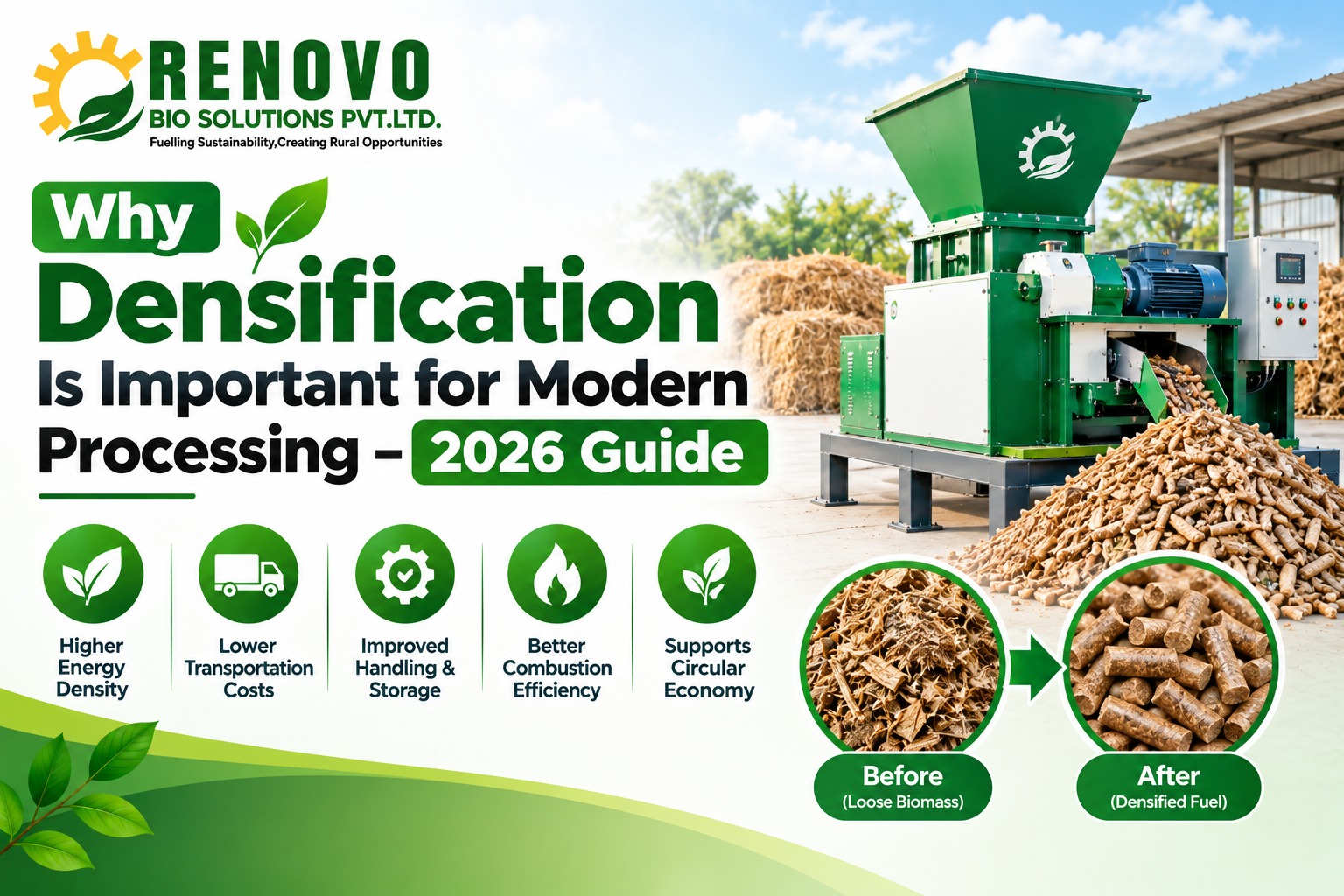
In modern agri-residue processes, densification is being increasingly used not only as a method for reducing the biomass volume but is playing an important role in the process as well. Efficient Densification can make material handling and storage at a CBG plant and also improve the availability of raw material at the biomass processing plant working in difficult operating conditions more efficiently. Renovo Biosolution is dedicated to real-world solutions for biomass densification which acts as a component of an overall pre-processing and storage system.
What Is Densification in Biomass Processing?
Densification can be achieved by compressing loose agricultural wastes into a smaller, more convenient and usable form, typically by briquetting. It can be a problem to efficiently manage raw biomass due to its low bulk density, and it can take up a lot of storage space.
The briquetting process alters the physical characteristics of the material and simplifies stacking, transporting, storing and handling. This can provide another time margin for the CBG plants between biomass collection and continuous operation in the digester.Thus, the densification value should be evaluated, both process and storage perspectives should be considered.
Why Briquetting Is More Than Compaction
The effect of briquetting on biomass structure is one of the underestimated benefits of the briquetting process. Compression occurs when there is a force or pressure acting on the material, which can cause changes to the structure of the material that may affect further processing.
During Densification, under the appropriate operating conditions, lignin in biomass can be softened and move towards the surface. This may change the physical properties of the material and may have benefits for the subsequent biological process.How it is affected is dependent on the composition of the feedstock, moisture, pressure, temperature and equipment setup. Renovo Biosolution , the densification needs to be considered in the overall processing chain and not just as a volume reducing step.
Storage Advantages of Densified Biomass
The low bulk density and irregular shape of loose agricultural residues make up-taking a lot of space. One of the challenges that can arise in a CBG plant is ensuring adequate feedstock supplies for continuous operation, which can lead to storage issues.
Densified briquettes allow them to be stored in a much smaller disposal. For a plant, the target storage volume of about 1,000 ton/plant can be achieved in around 4,000-5,000 sq. ft. depending on briquette density, stacking and access and storage designs.This can help to create an operational cushion if access to fresh biomass is temporarily lost or biomass is being pre-processed.
Creating a Feedstock Buffer for CBG Plants
A steady feedstock preparation is required for Hoshiarpur In Punjab. But, collection and processing of agricultural residues cannot be done continuously.
The supply of raw material may be impacted by monsoon weather, equipment issues, transport and temporary collection interruptions.Localization of biomass can contribute to a reserve which can keep the plant functioning even if fresh agricultural residues are not available for processing on the spot.An agricultural residue sourcing facility in Hoshiarpur In Punjab, for instance, might have to consider the seasonal nature of the weather, the collection times, and local conditions for storing the residues when managing its feedstock buffer.
Densification During Monsoon Conditions
One of the most severe conditions for agri-residue CBG plants is heavy rainfall. A high moisture content makes it difficult to recover biomass from the storage yards, and it can also have an impact on shredder, dryer and hammer mill performance.During these times, an alternative source of feed can be the stored briquettes. It is not necessary to rely completely on new material that will flow through the pre-processing line, the plant can utilize its stock until the condition for collecting and processing improves.
Integrating Densification With Pre-Processing
Densification shouldn't be considered as an end-of-line machine. It is best suited to be used in conjunction with other biomass preparation processes.
There are several strong architectural features that can be incorporated in a robust design:
- Moisture monitoring
- Optional bypass-capable drying
- Appropriate milling equipment to fine sizing.
- Briquetting or densification
- Planned storage capacity
- Feeding under control towards the digestion process.
The aim is to develop a processing sequence that will be capable of adapting to variations in feedstock quality and operating conditions.
Why Flexible Pre-Processing Matters
The bales of agricultural residues come in different sizes, moisture content, fibre structure, ash content and availability. If material conditions (actual) vary from those assumed in the plant design, problems can arise.
A flexible shredder that can be used with other bale sizes. A dryer which is capable of bypassing can not have to dry if the moisture is already suitable. Controlled fine sizing can be achieved with a hammer mill and densification can be used to turn prepared biomass into a dense storage form.Rather than blindingly trying to densify as a standalone solution, Renovo Biosolution can tackle this challenge as a part of the whole integrated solution.
Storage Planning for Large Biomass Inventories
The tonnage to be stored is not enough to be the only factor considered for the storage of processed biomass. Another factor to take into account is access, fire safety, moisture protection,Nagpur in Maharashtra , loading/unloading requirements, and inventory rotation.
A small briquette shape can help to optimize the use of the ground space, however, the storage space should still be designed based on the local operating and safety conditions.When selecting the sourcing radius, transportation cycles, seasonal availability and the number of buffer days are the considerations that should be included in the storage planning for a facility that sources biomass from Nagpur in Maharashtra.
Densification and Operational Resilience
A biomass plant is more resilient if it is not solely reliant on an operating condition. One approach to achieve this flexibility is the Densification of processed biomass in a form that can be stored until it is needed.
If the upstream line is not operating, then the briquettes can be manufactured and stored. Saurashtra In GujaratOther material stored can be a backup if the processing line is temporarily down.This can decrease the effect of interruptions which may occur in the short term and allow for a more systematic management of feedstock availability by the plant.
Energy and Process Considerations
The densification process itself involves mechanical energy, and should be considered as a whole plant economic process. Nagpur in Maharashtra Operating performance can be affected by feedstock moisture, particle size, density, binder requirements (if any), briquetting pressure, throughput and efficiency of the equipment.
It is not enough to just obtain the maximum density. The properties of the briquettes required should be matched to the requirements for handling, storage, transportation and downstream processing.A proper system optimises the densification performance and energy consumption and maintenance.
Regional Feedstock Planning
There can be conditions and feedstock availability that vary by agricultural region. Local crop residues, collection practices, storage and transportation distances are important factors to consider when formulating a densification strategy, depending on the plant's location, like that in Saurashtra In Gujarat .This should then be factored into the design of processing capacity and storage inventory for the region. This supports the actual feedstock supply chain, and not just occurring in parallel to it.
How Densification Supports 365-Day Processing
Two independent processing lines, flexible shredding, drying, fine sizing and densification of the product and adequate storage can result in a more robust pre-processing architecture.
The aim is not to ensure a continuous operation of the plants but to diversify the need for a single processing path and to offer other solutions to the loss of one process segment. Saurashtra In GujaratThe densified biomass can provide a good strategic reserve of feed stocks to sustain digester feeding when it is disrupted if it can be adequately collected and processing infrastructure is properly planned.
Densification Trends for 2026
Reliability, resource utilization, automation and year-round plant operation are the main concerns of biomass processing for 2026. Densification falls under this approach as it 'bridges' processing to storage and feedstock management.
Today, systems have the ability to incorporate production monitoring, inventory management, automatic feeding, moisture management and equipment condition monitoring. This enables operators of plants to treat processed biomass as an operational resource, rather than just as biomass stored.Renovo Biosolution can take this integrated approach, taking into account the densification, pre-processing and storage needs at the time the biomass plant is planned.
How to Plan a Densification System
Plant operators need to consider the following before using a briquetting system:
- The type of agricultural residue is indicated.
- Precipitation – water received and recorded.
- Required briquette density
- Daily processing capacity
- Desired storage inventory
- Available storage area
- Briquette handling requirements
- Energy consumption
- Maintenance requirements
- Seasonal feedstock availability
- Downstream feeding requirements
Conclusion
Densification is much more than a method of compacting agricultural residues. Briquetting can enhance physical handling of the biomass, enhance the space efficiency of the biomass storage, and provide a valuable feedstock buffer for Nagpur in Maharashtra .
In conjunction with flexible shredding, moisture-managed drying, fine sizing and proactively planned storage, densification can help to create a more robust pre-processing architecture Saurashtra In Gujarat. This is especially critical during periods of disruptions or temporary shut down of the upstream processing line caused by the monsoons.The choice of the right approach will depend on the feedstock properties, plant capacity, storage conditions and downstream process conditions. Renovo Biosolution can be used as a biomass processing strategy in a larger system that is intended to achieve source control of biomass.
FAQs
1. What is the purpose of densification in biomass processing?
Densification refers to the process of turning the loose agricultural wastes into briquettes which are easy to handle, transport and store.
2. How does briquetting help CBG plants?
Can build up a smaller reserve of processed biomass that can be utilized in cases of temporarily limited collection or pre-processing of fresh feedstock.
3. Can densified biomass support monsoon operations?
Yes, preserved briquettes can be used as a feed source in addition to biomass during periods of heavy rain when it is difficult to collect or process biomass.
4. How much storage space can densified biomass require?
Storage requirements depend on briquette density, stacking arrangement, access space, and safety provisions. Under suitable planning conditions, around 1,000 tons may be planned within approximately 4,000–5,000 square feet.
5. Is densification useful for all agricultural residues?
The suitability depends on feedstock characteristics such as moisture, fibre composition, particle size, bulk density, and the required briquette properties.
6. What equipment can be combined with a densification unit?
A complete pre-processing system may include shredders, dryers, hammer mills, conveyors, densification equipment, and storage systems.
7. Why is storage important for year-round CBG operation?
Storage provides a buffer against seasonal collection problems, weather disruptions, maintenance downtime, and temporary interruptions in biomass processing.
8. What should be considered before selecting a briquetting system?
Feedstock type, moisture, required throughput, briquette density, energy consumption, storage capacity, maintenance requirements, and downstream handling should be evaluated.